"All for one, and one for all!"— The Three Musketeers (Alexandre Dumas)
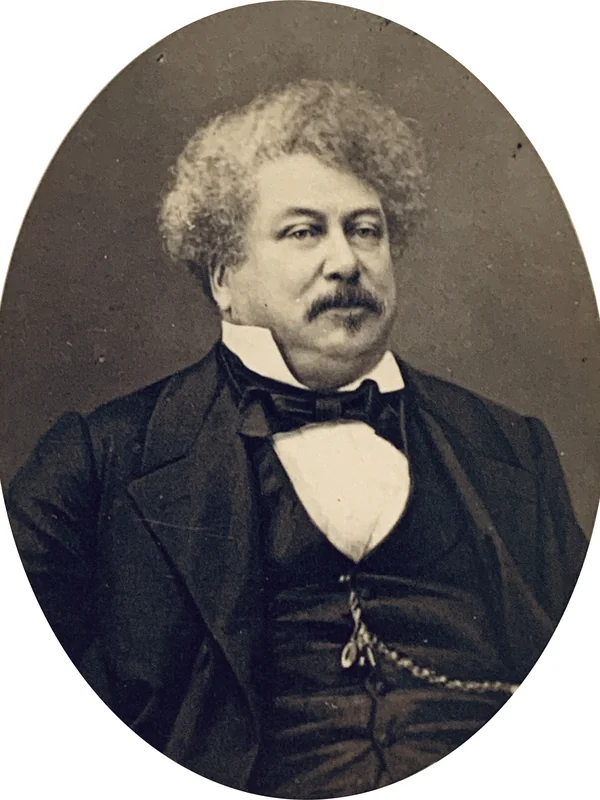
Alexandre Dumas
The man behind the Three Musketeers
Alexandre Dumas was born in a small French village. His father was one of the most extraordinary men in French history, General Thomas-Alexandre Dumas, the son of a Haitian woman of African descent and a French nobleman. Thomas-Alexandre rose to be a top general in Napoleon's army, the highest-ranking person of African descent in any European military for centuries.
But Alexandre's father died when Alexandre was 3, leaving the family poor. Alexandre grew up reading anything he could get his hands on. He was tall, strong, and full of energy. As a young man he moved to Paris and made friends with the giants of French literature.
Quick Facts
- Born: July 24, 1802
- From: Villers-Cotterêts, France
- Job: Novelist, playwright, traveler
- Famous for: The Three Musketeers, The Count of Monte Cristo, The Man in the Iron Mask
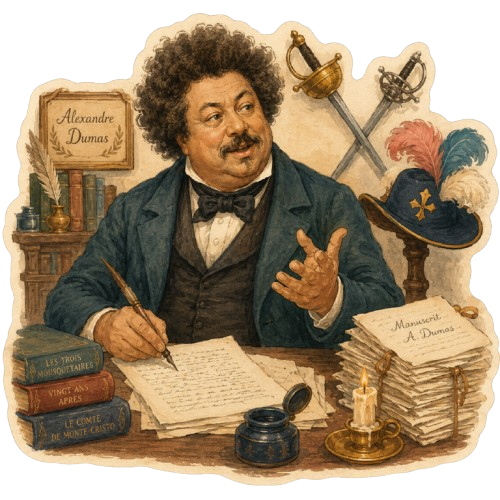
Dumas wrote SO MUCH that he hired teams of assistants to help him. He was the boss; they did research, drafted chapters, and he revised. The system let him publish at incredible speed.
His Famous Stories
Read Dumas's stories on Worldly
Dumas wrote the most thrilling sword-and-honor adventures of his time. On Worldly, every page is adapted to your reading level.
1844A young country boy named D'Artagnan goes to Paris to become a Musketeer. He makes three friends, Athos, Porthos, and Aramis, and adventure follows.
1845A young sailor is wrongly thrown in prison. After 14 years he escapes, becomes incredibly rich, and starts taking revenge on the people who betrayed him.
1847A mysterious prisoner with an iron mask covering his face turns out to be... the secret twin of the King of France. Now what?
His Life, Year by Year
Sword-fighting through French history
Dumas didn't just write about adventure, he LIVED an adventurous life, with duels, exile, and dramatic comebacks.
Born in a French village
Alexandre Dumas is born in Villers-Cotterêts, France. His father, the famous General Dumas, dies when Alexandre is just 3.
He goes to Paris
Alexandre moves to Paris with very little money. He finds work as a clerk and starts writing plays on the side.
His first play hits
Alexandre's play Henri III and His Court opens in Paris. It's a smash. He's famous overnight.
The Three Musketeers
Dumas publishes The Three Musketeers as a serial in a French newspaper. Readers go wild. The musketeers, D'Artagnan, Athos, Porthos, and Aramis, become legends.
The Count of Monte Cristo
Dumas publishes The Count of Monte Cristo, about a man wrongly imprisoned who escapes and methodically takes revenge on everyone who wronged him. Massive hit.
He builds his own castle
With his fortune, Dumas builds a fancy estate near Paris called the Château de Monte-Cristo. He throws huge parties. He spends faster than he earns.
Bankrupt, in exile
Dumas has spent all his money. To escape his debts, he flees to Belgium. He keeps writing.
He fights for Italian independence
Dumas joins Italian revolutionary Giuseppe Garibaldi in Italy and helps fund a small army. He writes about it.
End of an enormous life
Dumas dies near his son in Normandy at age 68. He had written hundreds of books, fought duels, gone bankrupt, and made the world love French adventure stories. In 2002, 132 years after his death, his remains were moved to the Panthéon, France's burial place for heroes.
His Famous Crew
Three groups of friends Dumas made famous
Dumas's characters became symbols of friendship, revenge, and honor that still shape adventure stories today.
Three Musketeers · 1844
All for one
D'Artagnan, Athos, Porthos, and Aramis swore, "All for one and one for all." The line became one of the most famous oaths in world literature. Every band-of-friends adventure since owes them.
Monte Cristo · 1845
Revenge done right
Edmond Dantès is wrongly imprisoned for 14 years. He escapes, finds a treasure, and patiently takes revenge on the men who put him there. The original "revenge served cold" story.
Iron Mask · 1847
A king's secret twin
A man imprisoned for life with an iron mask over his face, who is he? Dumas spun a wild story that he was the secret twin of the King of France. The legend has been retold a hundred times.
Wait… really?!
Six surprising things about Dumas
His father was a famous general
Dumas's father, Thomas-Alexandre Dumas, was one of Napoleon's top generals, and the highest-ranking man of African descent in any European military for centuries. Napoleon and Dumas's father had a famous falling out.
He wrote with a team
Dumas was so productive that he hired assistants to help with research and rough drafts. His main collaborator was Auguste Maquet. The system let Dumas publish at superhuman speed.
He fought duels
Dumas was tall, strong, and quick to fight. He was challenged to many duels and fought several of them. Like his musketeers, he didn't shy from a fight.
His estate had a moat
Dumas's Château de Monte-Cristo had a moat, gardens, exotic animals, and a small writing house called the Château d'If, named after the prison in Monte Cristo. He went bankrupt building it.
He went to the Panthéon in 2002
After being mostly forgotten for decades, Dumas was 'rehabilitated' in 2002, his remains were moved to the Panthéon (where France buries its national heroes) at the request of President Jacques Chirac.
He wrote a famous COOKBOOK
At the end of his life, Dumas wrote The Great Dictionary of Cuisine, a giant cookbook with thousands of recipes. He loved eating as much as he loved adventure.
Good questions, answered
Alexandre Dumas FAQ
Did Dumas really write 250 books?+
He wrote a LOT, somewhere between 100 and 250 depending on how you count. He used a team of assistants to help with research and drafts, which is why historians disagree on the exact number.
Are the Three Musketeers real?+
Sort of! Dumas based them on a real group of king's musketeers who served in the 1600s, and on a real D'Artagnan (Charles d'Artagnan, a captain in the king's guard). But the wild adventures in the book are all Dumas.
What's the famous quote from the Musketeers?+
'All for one, and one for all!' (in French, 'Tous pour un, un pour tous!') It's the Musketeers' oath of friendship, and one of the most quoted lines in French literature.
What age are Dumas books good for?+
The original Dumas books are LONG and have lots of dueling, intrigue, and political detail. The Worldly versions are adapted for ages 9 and up, streamlined for fast reading.
Why is he called 'Dumas père'?+
Because his son was ALSO a famous writer with the same name! Alexandre Dumas the elder is called 'Dumas père' (Father) and his son is 'Dumas fils' (Son). Dumas fils wrote the play that became the opera 'La Traviata.'
Ready for an adventure?
Dive in with Alexandre Dumas
More Dumas stories coming soon to Worldly. Sign up to be the first to know.