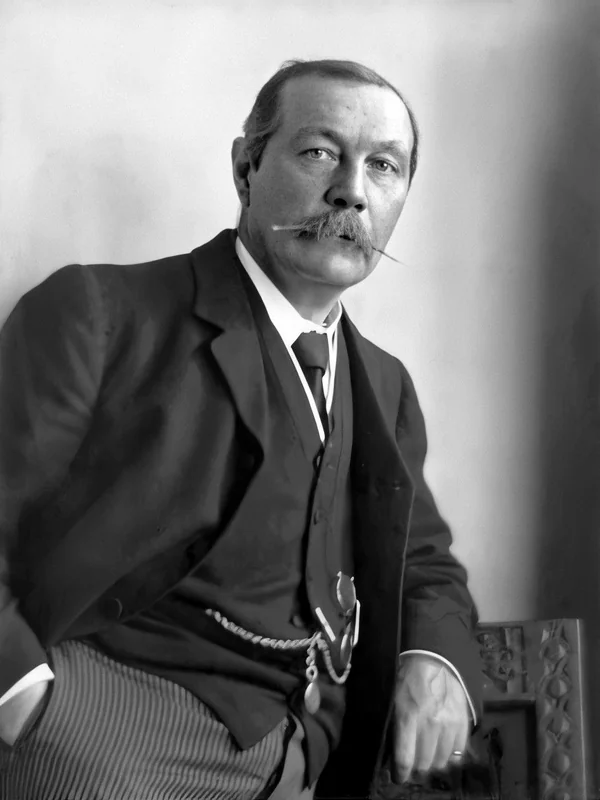
"It is a capital mistake to theorize before one has data."— Sherlock Holmes (Arthur Conan Doyle)
Arthur Conan Doyle
The doctor who created Sherlock Holmes
Arthur Conan Doyle grew up in Edinburgh, Scotland, in a family that didn't have much money. He studied medicine at the University of Edinburgh, and there he met a teacher who would change his life, Dr. Joseph Bell.
Dr. Bell could look at a stranger and tell you, in about 30 seconds, where they'd been, what they did for work, and what was wrong with them, just by noticing little details. That's where his shoes have brick dust from the construction zone. His left thumb is calloused, he's a left-handed carpenter. Arthur was amazed.
Quick Facts
- Born: May 22, 1859
- From: Edinburgh, Scotland
- Job: Doctor & writer
- Famous for: Sherlock Holmes stories
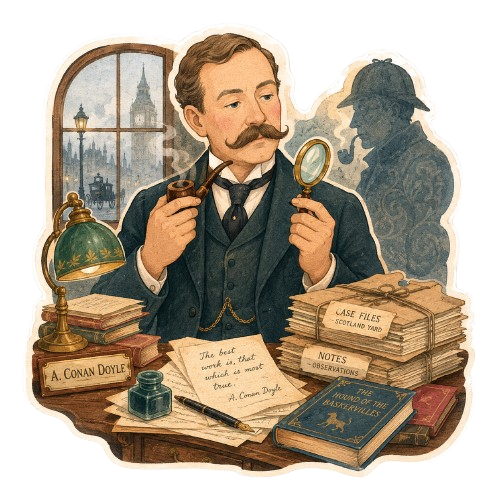
Doyle once tried to kill off Sherlock Holmes by throwing him off a waterfall. Fans were so angry that he had to bring Holmes back to life, eight years later.
His Famous Adventures
Read Doyle's stories on Worldly
Sherlock Holmes works because the mysteries are solvable, if you pay attention to the clues. On Worldly, every page is adapted to your reading level.
 ★ On Worldly
1892Twelve famous mysteries solved by Holmes and Dr. Watson. A mysterious red-headed league, a strange dancing-men code, a missing racehorse, every one is a puzzle.
1902A wealthy family is being hunted by a ghostly hound on the misty English moors. Can Holmes prove there's a real culprit behind it?
1887The very first Sherlock Holmes book. The detective and Dr. Watson meet for the first time, and solve a murder in a dusty London room.
His Life, Year by Year
From empty waiting rooms to writing fame
Arthur Conan Doyle wanted to be a doctor. He ended up creating the most famous detective ever written, and didn't even like writing the detective stories.
Born in Edinburgh
Arthur Conan Doyle is born to a struggling family in Edinburgh, Scotland. His dad is an artist with a drinking problem; his mom is a great storyteller who reads to him every night.
Medical school in Edinburgh
Arthur enrolls at the University of Edinburgh to study medicine. There he meets Dr. Joseph Bell, who can identify a stranger's life story with a glance.
An empty doctor's office
Arthur opens his own medical practice in Portsmouth. Almost no patients come. To pass the time, and earn money, he starts writing stories.
Sherlock Holmes is born
Arthur publishes A Study in Scarlet, the first Sherlock Holmes novel. The detective uses Dr. Bell's deduction trick to solve a crime. The book is a quiet hit.
Sherlock becomes a phenomenon
Arthur starts publishing short Sherlock stories in The Strand magazine. Readers line up at newsstands every month for the next issue. Holmes becomes the most famous character in the world.
He tries to kill Sherlock off
Arthur is tired of writing detective stories. He sends Sherlock over the Reichenbach Falls with his arch-enemy and kills him. Readers send angry letters by the thousands. Some wear black armbands.
The Hound of the Baskervilles
Arthur publishes a NEW Sherlock story (set before the death), the spooky gothic mystery The Hound of the Baskervilles. Fans go wild.
Sherlock comes back to life
Arthur finally gives in and brings Sherlock back. Turns out he survived the waterfall. Fans rejoice. Arthur keeps writing about him for another twenty years.
End of a long career
Arthur dies at age 71. He'd written over 60 Sherlock stories plus historical novels, science fiction, and books about Victorian fairies he believed were real.
How Sherlock Solves Mysteries
Three things Sherlock does that no one had done before
Sherlock Holmes invented the way modern detectives work, in fiction AND in real life. Police departments around the world studied his methods.
Method #1
Notice everything
Sherlock can tell where you've been today by the dust on your shoes, the mark on your wrist, the way you wear your hat. "You see, but you do not observe," he tells Watson.
Method #2
Reason backward
Most detectives start with a suspect and look for clues. Sherlock starts with the clues, and follows them, step by step, to the only person who could have done it.
Method #3
Eliminate the impossible
"When you have eliminated the impossible, whatever remains, however improbable, must be the truth." Real detectives still quote him.
Wait… really?!
Six surprising things about Arthur Conan Doyle
Sherlock was based on a real person
Dr. Joseph Bell was Arthur's medical school teacher. He could guess a stranger's life story just by looking at them. Arthur turned him into Sherlock Holmes.
He tried to kill Sherlock
Doyle got bored of writing Sherlock stories and tried to end the series by killing the detective. The public hated it so much he had to bring Holmes back eight years later.
He helped solve real crimes
Fans wrote to Sherlock Holmes at 221B Baker Street asking for help. Doyle sometimes investigated real cases himself, and helped clear two innocent men accused of murder.
He believed in fairies
Late in life, Doyle became convinced that fairies were real after seeing photos two young girls had faked. The girls later admitted the hoax.
He was a doctor on a whaling ship
After medical school, Doyle worked as the ship doctor on a whaling boat in the Arctic. He wrote about it later, the cold, the danger, the seasickness.
He played sports
Arthur was tall, strong, and played cricket, golf, and rugby. He once batted against W.G. Grace, England's most famous cricketer. He even helped popularize skiing in Switzerland.
Good questions, answered
Arthur Conan Doyle FAQ
Did Sherlock Holmes really exist?+
No, Holmes was fictional. But he was based on a real person, Dr. Joseph Bell, Doyle's medical school teacher in Edinburgh. Bell could guess a stranger's life story by looking at them, and that talent became Holmes's superpower.
Why did Doyle try to kill Sherlock?+
Doyle wanted to write 'serious' historical novels and felt Sherlock was a distraction. So in 1893, he killed Holmes off. The public was furious, thousands of fans wrote angry letters. After eight years, Doyle gave in and brought Sherlock back.
Is Sherlock Holmes good for kids?+
Yes! Holmes stories are puzzles to solve, not scary horror. The Worldly version simplifies the Victorian language and softens any violence, so kids ages 7+ can enjoy them.
How many Sherlock Holmes stories are there?+
Doyle wrote 4 Sherlock novels and 56 short stories, 60 stories total. They're often called 'the Canon.' Many other writers have written their own Sherlock stories since, but Doyle's are the originals.
Did he really believe in fairies?+
Yes, sadly! Late in his life, Doyle became convinced that two English girls had taken real photos of fairies in their garden. The girls later admitted the photos were fakes, but Doyle defended them for years.
Ready for an adventure?
Dive in with Arthur Conan Doyle
Start with The Adventures of Sherlock Holmes, adapted to fit your reading level. Free in the Worldly app.